
The Compliance Bottleneck: Getting People to Open Requests

Most compliance programs focus on completion rates.
How many employees signed the handbook? How many volunteers acknowledged the policy? How many team members completed the required review?
Those are important questions. But after analyzing policy review activity from active organizations using ClearPolicy, we found that completion may not be the most useful metric to watch first.
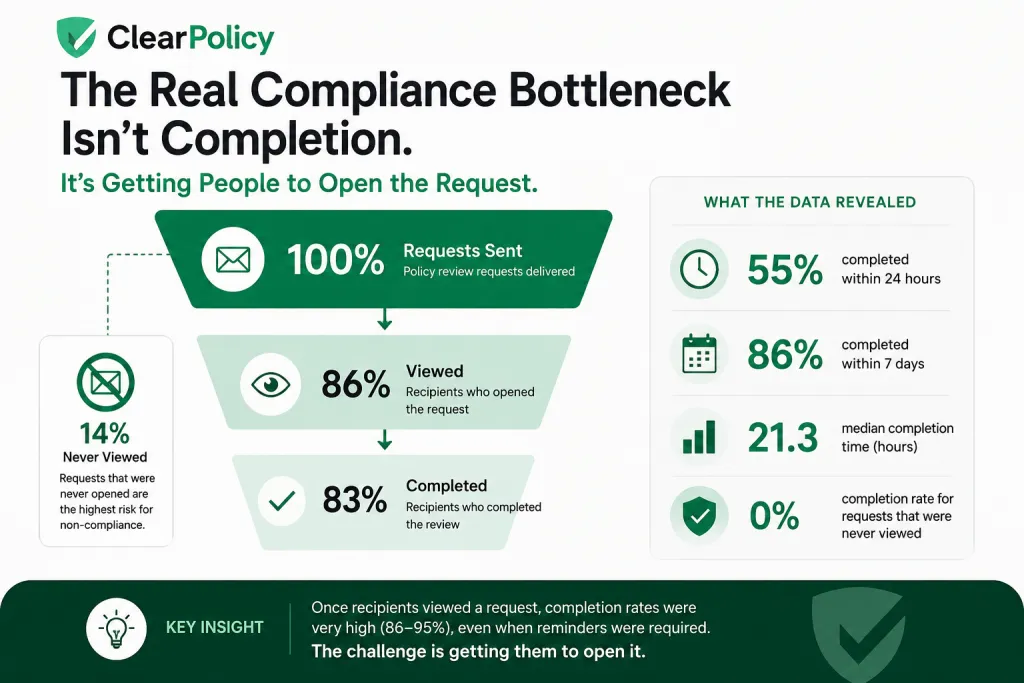
The strongest predictor of whether a policy review would ultimately be completed was whether the recipient ever opened the request.
Most Policy Reviews Are Completed Quickly
When recipients engaged with a policy review request, completion happened surprisingly fast.
Key findings from our analysis:
-
55% of completed reviews were finished within 24 hours
-
63% were completed within 3 days
-
86% were completed within 7 days
-
The median completion time was just 21.3 hours
At first glance, these numbers suggest that policy acknowledgement is a relatively simple process.
For most people, it is.
The challenge lies elsewhere.
The Average Doesn’t Tell the Whole Story
While the median completion time was less than one day, the slowest reviews took much longer.
-
75% of reviews were completed within 3.9 days
-
The slowest 10% took more than 11 days
-
The slowest 5% took more than 22 days
This creates a long tail that many administrators recognize immediately.
Most people complete required reviews quickly. A small group requires repeated follow-up and consumes a disproportionate amount of administrative effort.
The Strongest Signal Was Whether the Request Was Opened
When we looked deeper into reminder activity, a more interesting pattern emerged.
Requests that never reached the reminder stage had extremely high completion rates.
Among requests that required reminders, outcomes depended heavily on whether the recipient eventually opened the request.
Recipients who eventually viewed a request completed it at very high rates, even when reminders were involved.
By contrast, requests that never progressed to a view remained incomplete.
This suggests that the primary obstacle is often not understanding the policy, reading the document, or completing the acknowledgement.
The primary obstacle is getting the recipient to engage with the request in the first place.
Why This Matters for Compliance Teams
Many organizations treat all overdue policy reviews the same way.
In practice, there may be two very different groups:
Group 1: Viewed But Not Completed
These recipients have already engaged with the request.
A reminder may be all that is needed.
Group 2: Never Viewed
These recipients may require a different approach entirely.
The issue could be:
-
An overlooked email
-
An outdated email address
-
A volunteer who is no longer active
-
A staff member who needs direct manager follow-up
Treating these requests differently can help organizations focus their effort where it is most likely to have an impact.
What Organizations Can Learn
The lesson from this analysis is simple:
Don’t just track completions.
Track engagement.
If recipients are opening policy requests, completion often follows naturally.
If they are not opening them, additional reminders alone may not solve the problem.
For many organizations, the biggest compliance risk isn’t an incomplete acknowledgement.
It’s an acknowledgement request that was never seen at all.
Methodology
This analysis is based on anonymized policy review activity from active organizations using ClearPolicy between March and May 2026.
ClearPolicy tracks sent, viewed, and completed status for every request — so you can see which group a person falls into before sending another reminder. See how it works or explore policy acknowledgment software for small organizations.
Try ClearPolicy free for 30 days
Collect signatures, track who has signed, and run compliance reports — with reminders and version history built in.
No credit card required.